Best Pillow Height for Back Sleepers: How to Find the Right Support

Many people believe back sleeping is the most comfortable and healthiest sleep posture for dedicated back sleepers.
However, even when sleeping on your back, back sleepers might still wake up with a stiff neck, dull head pain, or even a pinched nerve.
The issue often isn’t the sleeping position itself, but whether your pillow height and support placement are correct. Many assume back sleeping only requires elevating the back of the head, completely overlooking the crucial need for neck support.
If your pillow only cradles your head while leaving an obvious gap under your neck, your cervical spine will remain in an awkward position all night.

💡 Core Takeaway: When choosing a pillow for back sleepers, the priority isn’t simply chasing a “high” profile. Instead, focus on finding a pillow that naturally contours to your cervical curve, offering comfortable and stable support for both your head and neck.
1. 3 Pillow Issues I Summarized From My Own Neck Pain Experiences
⚠️ 1. Pillow Too High
I once tried sleeping on a relatively high pillow. The next morning, I woke up with severe neck stiffness and tightness, almost like a stiff neck injury.
Even after lying down for 20 minutes, I couldn’t find a comfortable position, making me quickly realize that high profile wasn’t suited for me.
⚠️ 2. Pillow Too Low
When the pillow was too low, I didn’t feel much discomfort during the first 10 to 15 minutes and fell asleep easily.
But after using it for several consecutive days, I gradually noticed mild discomfort in my neck upon waking up. While not as painful as a high pillow, my neck never felt fully relaxed.
I also attempted sleeping completely without a pillow, but it made sleeping nearly impossible.
I tossed and turned all night, feeling noticeable strain whenever my head tilted backward. That experience confirmed that a pillow is far from optional—it is essential support for comfortable back sleeping.
* Note: These are my personal experiences under different pillow conditions and may not yield identical results for everyone. Ideal pillow height and firmness must be adjusted based on individual body structure, sleep habits, and mattress firmness.
2. How to Choose the Right Pillow Height for Back Sleepers
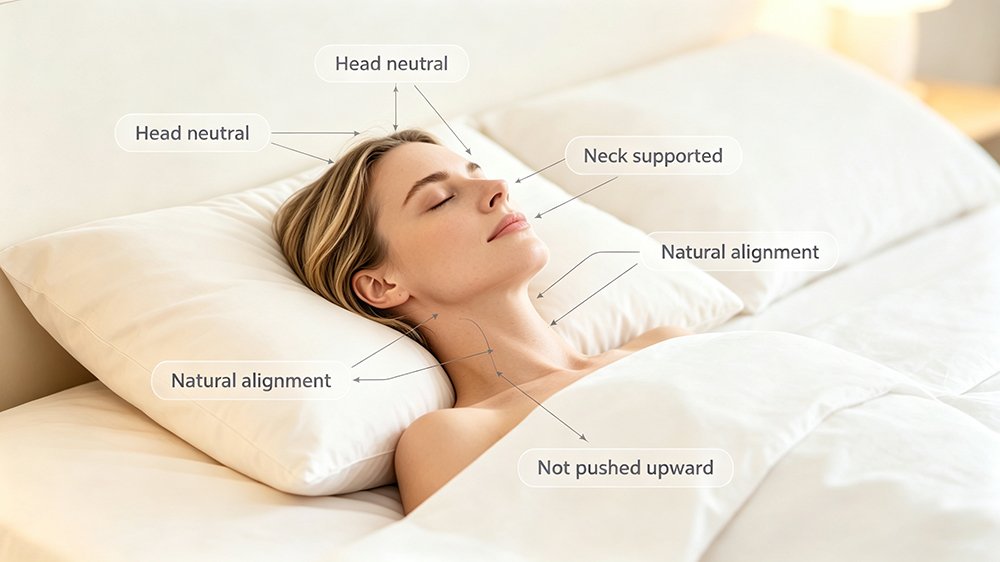
2.1 Moderate Height & Individual Differences
💡 For a deeper look into general loft standards across all sleep positions, explore our complete guide on How High Should Your Pillow Be?. Below is how to tailor these principles specifically for back sleeping:
Reference Height: For many back sleepers, 2 to 3 inches serves as a great starting reference range, though there is no fixed height that fits all.
According to medical research on spinal posture from Johns Hopkins Medicine, maintaining a neutral spinal alignment during sleep is critical to preventing chronic musculoskeletal strain. The actual height of your pillow should be fine-tuned according to personal body frame, shoulder width, mattress firmness, and pillow material.
Mattress Synergy: If your mattress is soft, your body sinks deeper, meaning back sleepers should opt for a slightly lower pillow. If your mattress is firm, your body sinks less, requiring a slightly higher pillow.
What truly matters is achieving a natural and comfortable head-and-neck alignment: your head shouldn’t tilt too far forward or backward, your neck should be properly supported, and you shouldn’t feel your neck being forcefully pushed upward.
2.2 Moderate Firmness (Balancing Support and Contouring)
Recommended Material: White Goose Down Pillows for Back Sleepers
White goose down pillows are renowned for being soft, lightweight, and plush. When you lay your head down, the fill shifts with pressure to create a gentle cushioning effect, avoiding the hard pressure against the back of your head that stiff pillows cause.
For back sleepers who want both cloud-like plushness and tailored neck alignment, moldable down pillows offer a key advantage: you can manually shift part of the fill toward the neck area based on your posture and body type, providing extra support right under your neck.
Because everyone’s natural cervical curvature varies, it is recommended to test a new pillow after purchase. The ultimate test is whether your neck feels zero gap, zero pressure, and complete muscle relaxation when lying flat.
3. How Do You Know If Your Back-Sleeping Pillow Is Right for You?
Chin vs. Forehead Alignment: Relax while lying flat, and check if the line between your chin and forehead is roughly parallel to the bed surface.
If your chin tilts upward significantly (forehead higher than chin), your pillow is too low. If your chin is pushed toward your chest, your pillow is too high.
Ideal State: A parallel alignment, keeping the natural forward curve of your cervical spine intact.
Neck Gap Check: While lying flat, extend your hand naturally with palm up and slide it into the gap behind your neck and the pillow.
If your palm snugly fills the gap without feeling squeezed or loose, the pillow height is correct for back sleepers.
If your hand is tightly pressed and hard to pull out, the pillow is too high. If your hand slides in effortlessly with empty space around it, the pillow is too low.
Body Response Tracking: Keep track of how your body feels upon waking up for a few consecutive days.
As noted by clinical experts at Harvard Health Publishing, waking up with morning neck stiffness is frequently tied to improper cervical support during rest. If you wake up feeling light in your neck, free of stiffness or soreness, turn your head easily, and feel refreshed, your pillow height is appropriate.
If you frequently experience stiff neck, shoulder aches, arm numbness, or morning dizziness, an incorrect pillow height may be the culprit.
Spine Line Inspection: When turning to your side, observe if your ears, shoulders, and hips align in a straight line.
If your head tilts toward the mattress or your shoulders hunch, the pillow height is unsuitable. Maintaining proper spinal alignment while back sleeping helps validate overall pillow suitability.
4. Most Common Mistakes Made by Back Sleepers
- Placing the pillow only under the head, leaving the neck completely unsupported: A pillow should support both the head and cervical spine, filling the neck arch to maintain natural curvature. Leaving the neck suspended causes neck muscles to stay tense all night, leading to stiffness and aches.
- Blindly chasing high pillows: Excessively high pillows force the cervical spine into excessive forward bending (similar to looking down at a phone for hours), straining neck muscles and potentially compressing vertebral arteries to restrict blood flow.
- Pillows that are too firm, pushing against the head while neglecting neck support: Overly firm pillows exert pressure on the back of the head while failing to contour around the neck. Back sleepers need a balance between plush softness and reliable support.
Over long-term use, down pillows may temporarily lose loft due to compression, making daily fluffing helpful to restore shape. You can also manually push fill toward the neck section for tailored support. - Changing mattresses without updating the pillow: A softer mattress increases body sinkage, raising the relative head position and requiring a lower pillow. A firmer mattress requires a higher pillow to fill the gap. Failing to match your pillow to your mattress breaks proper spinal alignment.
5. How to Improve Your Back-Sleeping Experience
- Manually adjust your white goose down pillow before sleep: Gently push the down fill toward the neck section, making the neck area fuller and the head area slightly thinner. This better fits the natural arch of your neck and eliminates gaps during back sleeping.
- Pair with a mulberry silk pillowcase: Silk is ultra-smooth and soft, reducing friction when your head turns at night. It minimizes hair frizz and static while reducing tugging on your skin and neck for an upgraded sleep experience.

- Place a thin pillow under your knees: If your lower back feels hollow or strained while sleeping on your back, try slipping a thin pillow under your knees to keep your joints slightly bent. Many back sleepers find this instantly releases pressure from the lower back.
6. My Summary of Back Sleeping Tips
When sleeping on your back, the key to choosing a pillow isn’t blindly seeking height, but ensuring your head and neck receive natural, comfortable support.
For many back sleepers, 2 to 3 inches serves as a great initial baseline, but final adjustments must account for your body shape, shoulder width, mattress firmness, and pillow materials.
The right back-sleeping pillow should cradle the back of your head naturally while stabilizing your neck without pushing your head forward or pulling it back. If you wake up after several days feeling light in your neck without stiffness or aches, the pillow aligns well with your body.
For lovers of plush sleep, white goose down pillows excel in lightness, fluffiness, and contouring comfort. Being able to shift filling manually allows back sleepers to customize neck support according to their unique body frame and sleep habits.
Ultimately, there is no single universal standard for the “perfect” pillow. Finding your ideal balance of height, softness, and support location is far more important than picking a generic high or low pillow.
ha