How to Choose a Pillow: The Ultimate Sleep Alignment Guide
If you are wondering how to choose a pillow that fits your bedding setup, you’re not alone. After long-term comparisons and testing over 300 models, we came to an important realization: no single option suits everyone.
Learning how to choose the right pillow isn’t about buying the most expensive option; it’s about focusing on proper height, compression levels, your primary sleeping position, body dimensions, and cervical alignment once you lie down.
When testing, we don’t just look at advertised dimensions. We observe real compressed height under body weight, firmness, responsiveness, neck support, and how comfortably the head shifts throughout the night.
Side sleepers need enough volume to bridge the gap between shoulder and head, while back sleepers need seamless contouring along the natural neck curve.
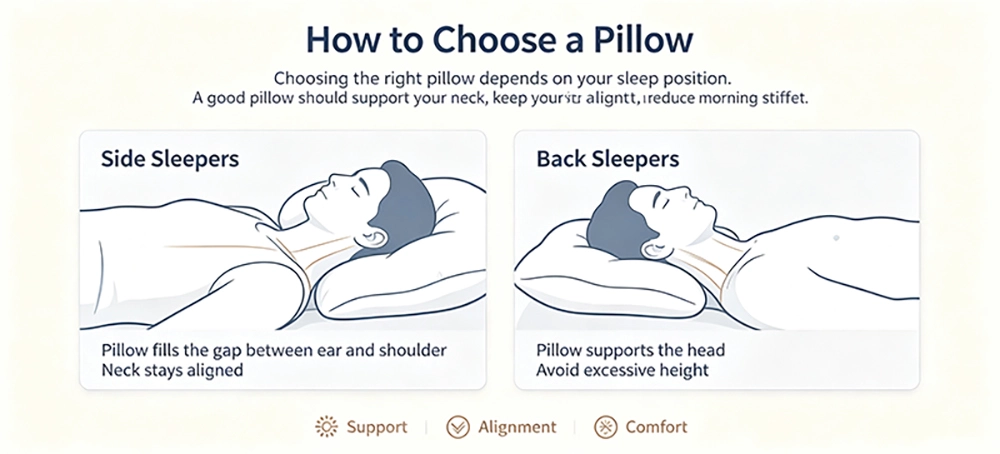

1. How to Choose a Pillow Height Based on Your Sleeping Position
Our practical tests show that height directly influences strain on the cervical spine. As noted in research by the Sleep Foundation, maintaining neutral spinal posture is critical for preventing long-term neck discomfort and fatigue.
- 1.1 Back Sleeping (Supine): Best suited for low-to-medium options (around 5–8 cm / 2–3 in compressed). The goal is filling the space behind the neck without pushing the head forward. Cervical support should be slightly raised (3–5 cm / 1–2 in higher than the center) to preserve your spine’s natural curve.
- 1.2 Side Sleeping: Benefits from higher support (roughly 10–15 cm / 4–6 in compressed). The height should match your shoulder width to bridge the gap between ear and mattress, keeping your head, neck, and spine horizontally aligned.
- 1.3 Stomach Sleeping (Prone): Requires extremely low loft (<3–5 cm / <1–2 in compressed) or skipping head elevation entirely. This reduces unnatural neck rotation and pressure on the upper spine.
Regardless of your preference, learning how to choose a pillow with the right loft is the most decisive factor for restful sleep.
Because shoulder width and body weight vary significantly, we recommend fine-tuning your setup based on whether you primarily rest on your back or side.

2. How to Choose a Pillow Material for Your Rest Style
1. Back Sleeping (Mainly Flat)
-
✅ Preferred Options: Memory Foam, Natural Latex, White Goose Down
- Memory Foam (Slow Rebound): Contours closely around the neck curve to relieve pressure points; opt for open-cell breathable designs if you tend to sleep hot.
- Natural Latex: Delivers medium firmness with fast bounce and excellent airflow. Aim for a compressed height around 8–10 cm (3–4 in).
- White Goose Down: A 3-chamber structure (soft outer down with a supportive inner feather core) cradles the head while keeping the cervical spine properly lifted.
- ❌ Use Caution: Pure down without core support can flatten out completely, leaving the neck unsupported.
Key Point: Back sleepers need a lower center pocket with elevated cervical contouring—avoid propping up only the back of the head.
2. Side Sleeping (Most Common)
-
✅ Preferred Options: Natural Latex, High Fill Power Goose Down
- Natural Latex: Resilient rebound prevents sinkage, filling the shoulder gap (12–15 cm / 5–6 in compressed height) to keep the spine straight. Great for hot sleepers.
- High Fill Power Goose Down (800+ FP): A feather core maintains height without collapsing overnight, keeping head and neck aligned.
- ❌ Use Caution: Standard synthetic fibers flatten quickly under heavy pressure, leading to lateral neck strain.
3. Combination Sleeping (Tossing & Turning)
-
✅ Preferred Options: Layered / Chambered Down Construction
Adapts fluidly between postures—offering gentle contouring for back sleeping and firm structural depth for side turns without collapsing.
- ❌ Not Recommended: Solid, dense memory foam, as its slow recovery can leave you temporarily without support during position changes.
4. Stomach Sleeping
Stomach sleeping places significant rotational torque on the cervical spine. Transitioning to side or back sleeping is generally recommended.
- ✅ If You Must Sleep on Your Stomach: Choose ultra-thin down or low-profile fiber designs under 3–5 cm (1–2 in) compressed height.
- ❌ Avoid: Firm latex, thick memory foam, or rigid materials that force the head backward.
3. How to Choose a Pillow for Specific Health Needs
-
3.1 Cervical Discomfort: If you frequently wake up with stiffness, prioritize adjustable designs or contoured ergonomic support.
According to health experts at Healthline, persistent pain should not be addressed solely through bedding changes—consult a specialist if discomfort continues.
- 3.2 Snoring Concerns: Switching from back to side sleeping often helps keep airways clear. Ensure your head height keeps the neck neutral rather than tilted too high or low.
Give any new setup a 3–5 night trial period to evaluate how your neck and shoulders feel each morning. If you experience persistent tightness, don’t force yourself to “get used to it.”
Still Unsure How to Choose a Pillow?

Discover our 900 Fill Power White Goose Down Set. Crafted with a supportive 3-chamber core and wrapped in 6A Mulberry Silk for effortless spine alignment and breathable luxury.
Explore BEST Goose Down SolutionsSummary Checklist: How to Choose a Pillow Quick Reference
| Your Sleep Style | How to Choose a Pillow Profile |
|---|---|
| Back sleeper | Low / Medium profile (approx. 5–8 cm / 2–3 in) |
| Side sleeper | Medium / High profile (approx. 10–15 cm / 4–6 in) |
| Combination sleeper | Adaptable 3-chamber construction |
| Stomach sleeper | Ultra-low profile (<3–5 cm / <1–2 in) or no elevation |
《How to Choose a Pillow》有1条评论
评论已关闭。